Santiago
Campuzano

Scientist, maker, and avid tennis player | Vancouver, BC

I work where cell biology meets software and hardware.

I received my BSc in food science from UBC, and drove to Ottawa to complete an MSc under Andrew Pelling at the University of Ottawa. Since 2020, I have been working in the Bioengineering team at STEMCELL Technologies.

Work

STEMCELL Technologies, Vancouver

STEMCELL Technologies

Senior Research Associate, 2020 to now

I have worked across the spectrum where life sciences meets engineering. From bioprinting and liquid handling robots to microscopy image analysis. See below some of the products I've worked on.

  • Still in cultureComing soon

    Organoid Analysis Tools (OATs)

    I lead cross-functional development of OATs, a web platform (Beta) to automate and standardize the analysis of organoid microscopy images. I dream of being able to provide scientists across the world with an accessible platform to conduct routine and end-point analysis.

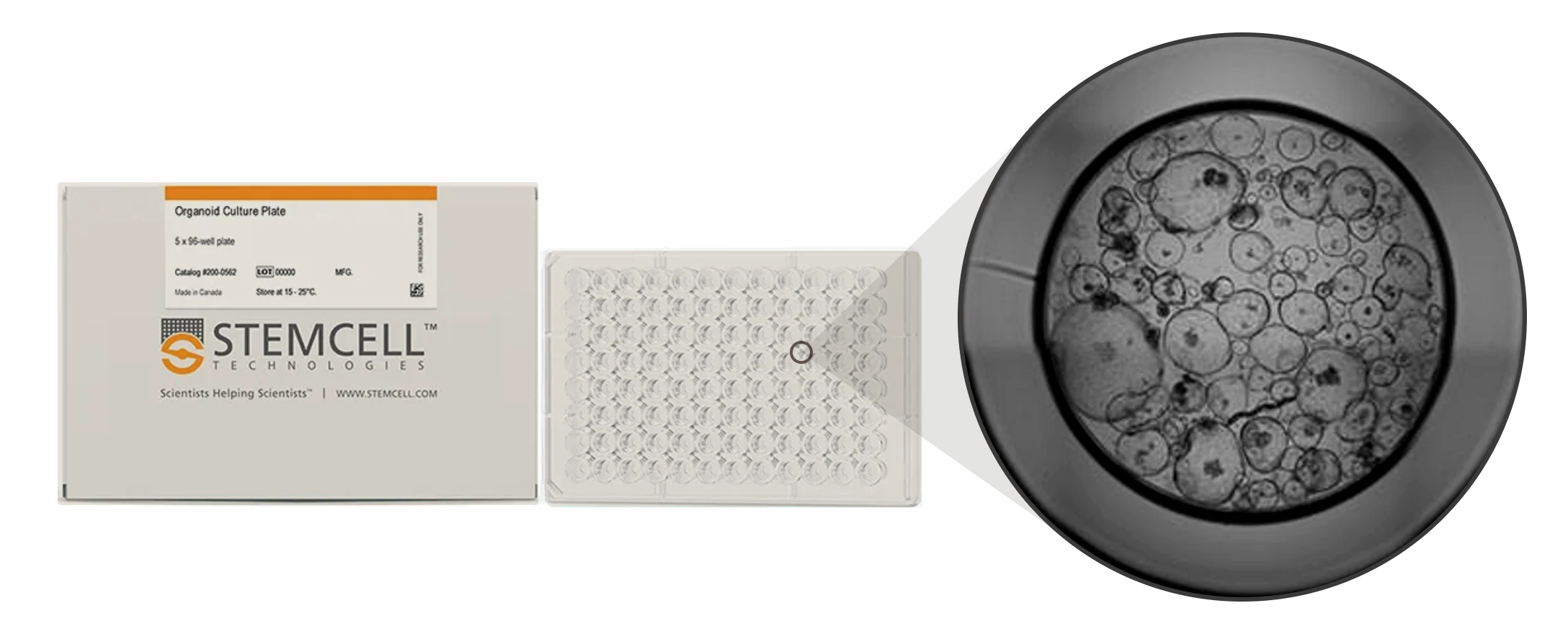
  • An Organoid Culture Plate beside its box, with one well magnified: organoids sit centred inside the stepped well
    Adapted from stemcell.com, STEMCELL Technologies

    Organoid Culture Plates

    I supported early development and prototyping of Organoid Culture plates: a stepped well sets the matrix to the same depth every time. Organoids that would grow in a dome sit centred and level instead, with no dead zone at the core and less meniscus in the way of the microscope. Unlike dome cultures, the plate needs no pre-warming, and it suits automated handling. These are provided as a 24 and 96-well plate.

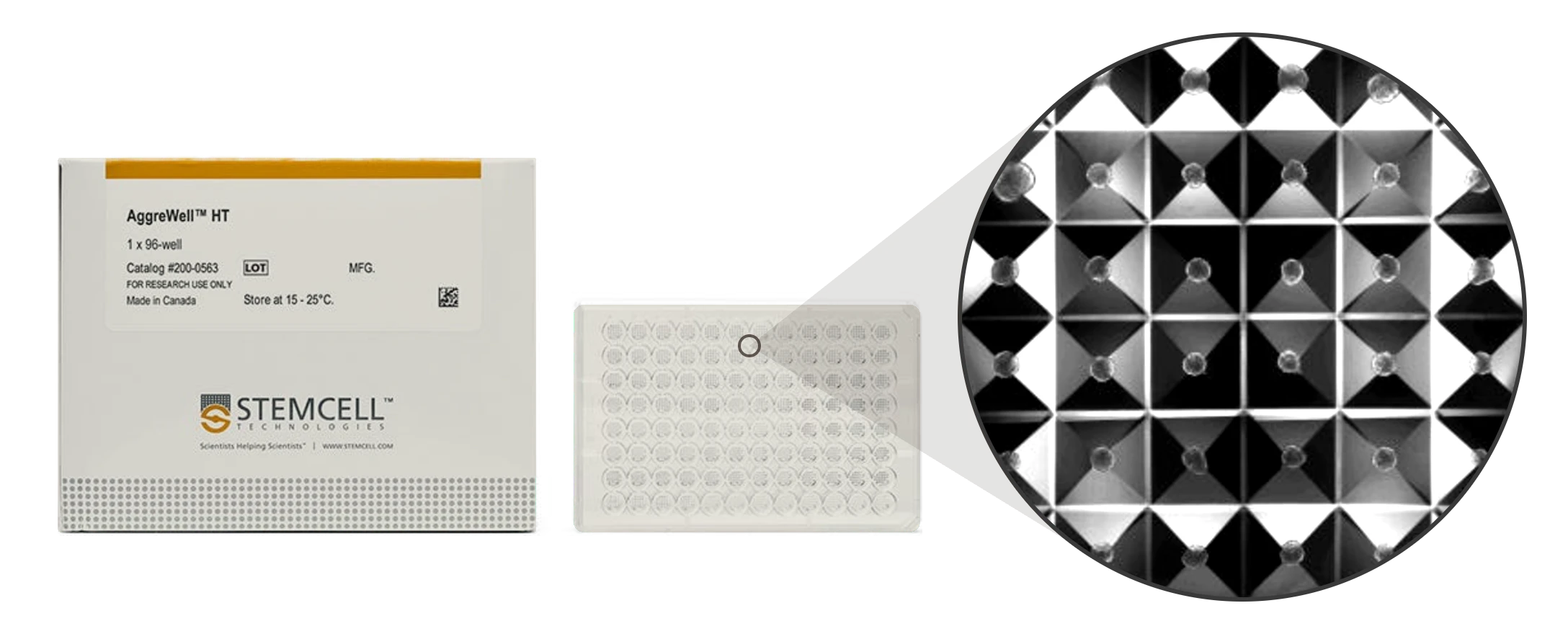
  • An AggreWell HT plate beside its box, with one well magnified: a grid of pyramid-shaped microwells, one aggregate in each
    Adapted from stemcell.com, STEMCELL Technologies

    AggreWell™HT

    A 96-well plate composed of wells layered with 32 microwells (900 x 900 µm), leading to the formation of 32 highly uniform embryoid bodies or spheroids. These plates allow for aggregation of as few as 50 cells per microwell. A meniscus-reducing ring keeps brightfield images clear, and the plate is compatible with robotic liquid handlers to support innate high-throughput nature.

Projects

Apps, printed hardware and lab hacks

SpinMap on a phone showing the next free courts at UBC

SpinMap

2026

SpinMap was developed to help consolidate all tennis-related information across the lower mainland. Every public tennis court from the US border to Hope on one map: what is at each one, how good the surface is, which courts are free in the next few hours across booking facilities. Lessons, leagues and closures show up before you drive over. Where there are no bookings, players check in to say how busy it is.

Play the demo, 17 s

SCellyCus

2018 to 2021, New Harvest seed grant

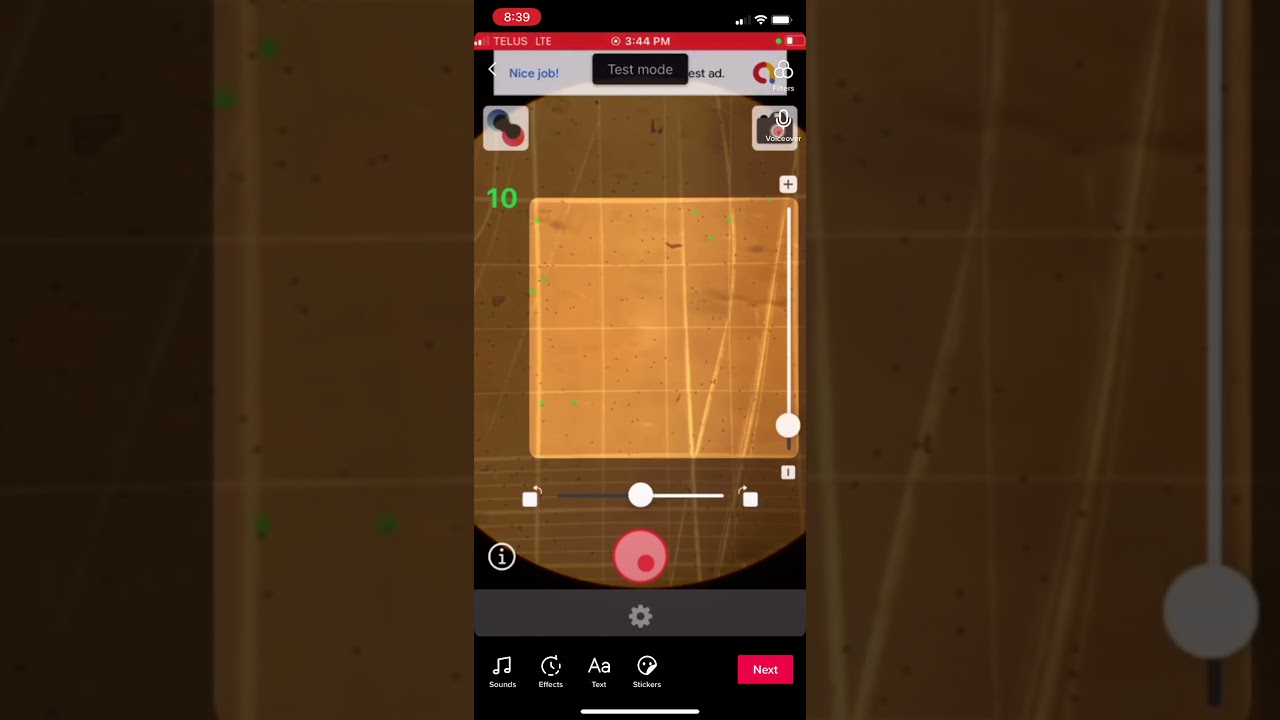
Most labs still count cells by eye on a hemocytometer. This is over 100 years old and still widely used. SCellyCus was an iPhone app that automated hemocytometer cell counts at near real-time, and provided the calculated cell concentration. SCellyCus was built primarily in Swift alongside Objective-C and C++ extensions.

Loading the parts…

Drag to turn, pinch or Ctrl/⌘ + scroll to zoom

SCellyCus adapter

2021, open design on Thingiverse

The app is only as good as the picture, so I designed a printable adapter in Fusion 360 that lines a phone's camera up with a microscope eyepiece. The open design has been downloaded more than 1,200 times. It is ten parts in twelve files, three of them the same nut. These are the real print files, lightly simplified to load fast, put together the way the printed one goes. Press Assemble to watch again, put it on a microscope, or pick a part to see it on its own.

Hacks

Research and Training

Biology at the University of Ottawa, food science at UBC

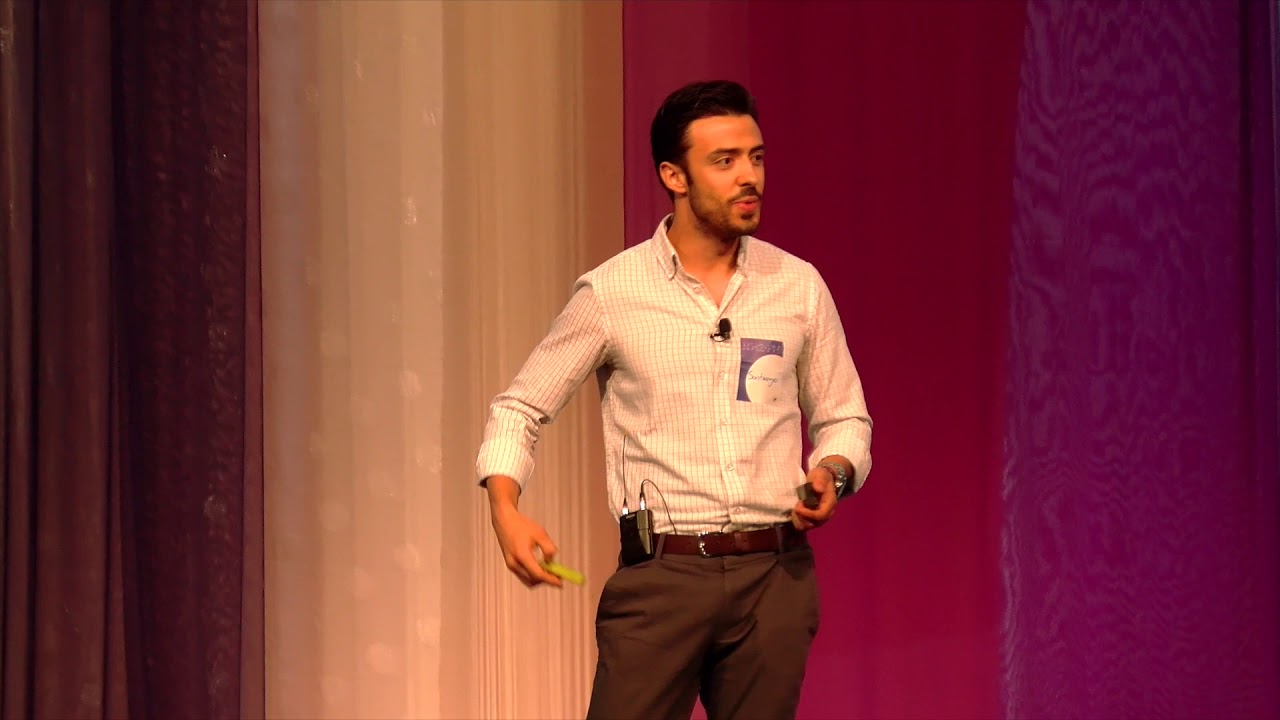
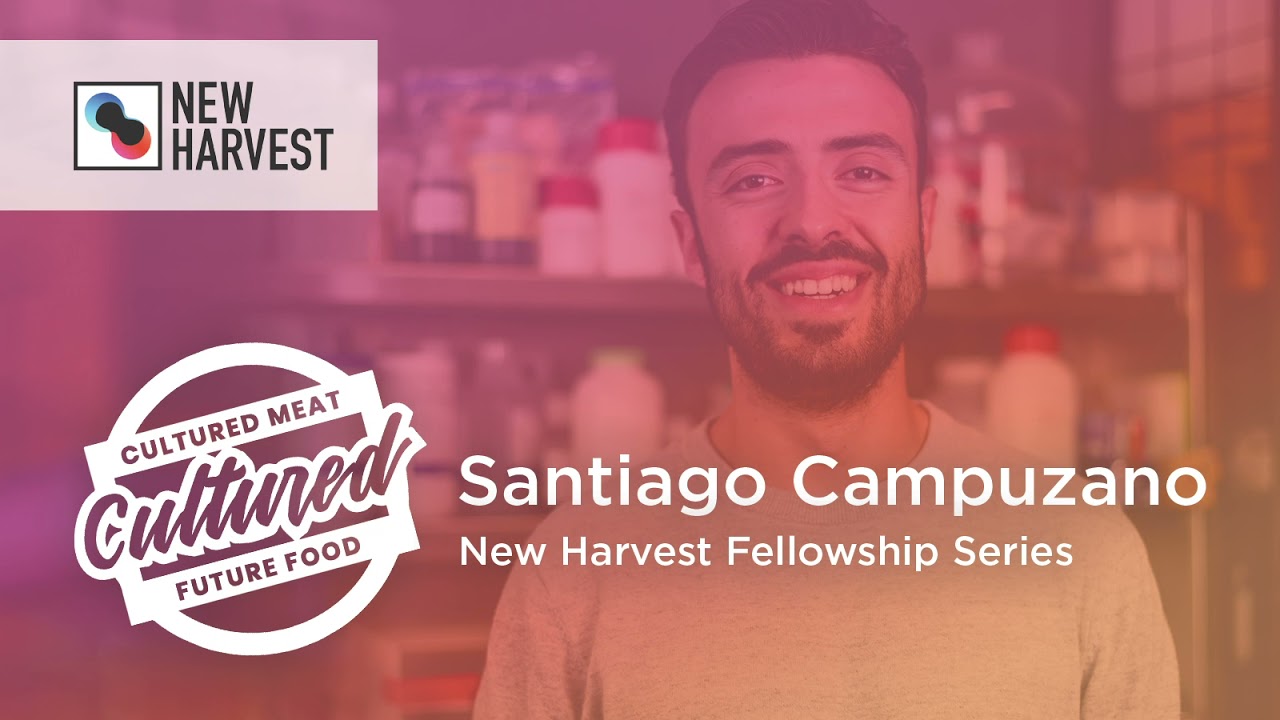
Play the talk, 13 min

Plant scaffolds

2017 to 2020, MSc in Biology, University of Ottawa

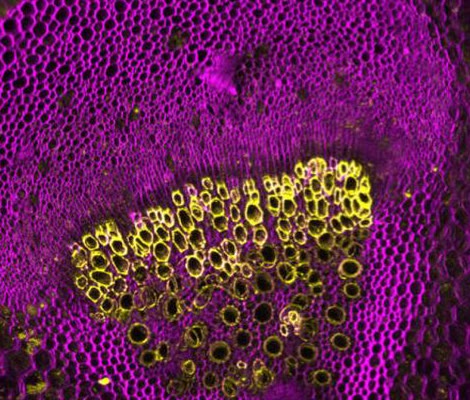
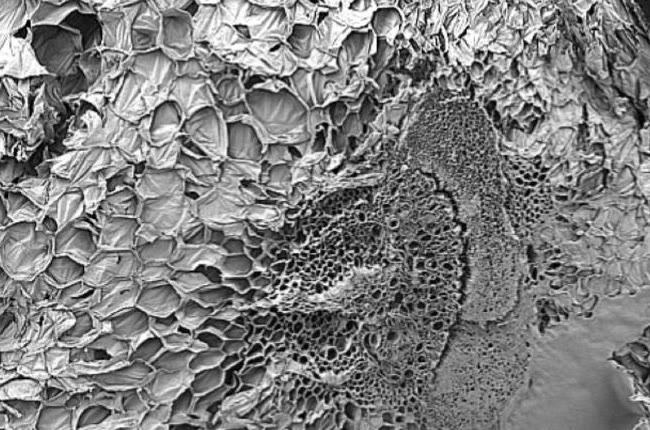
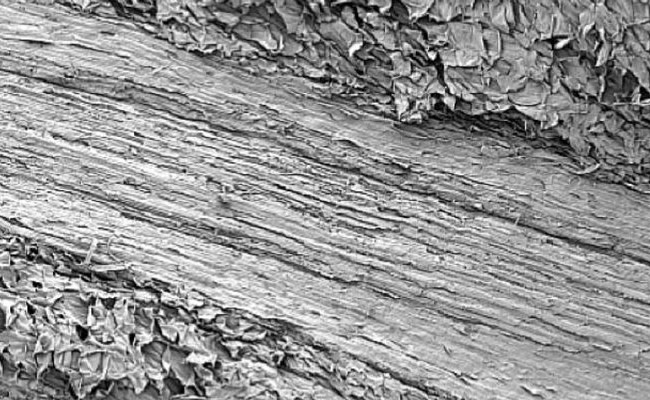
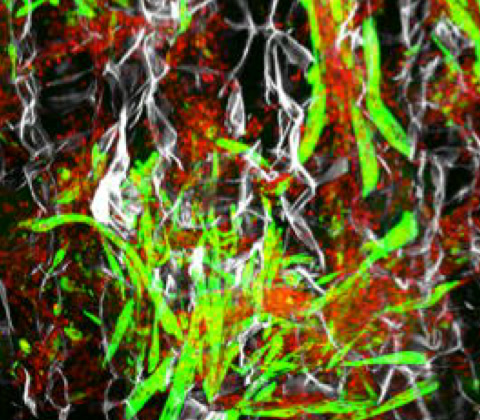
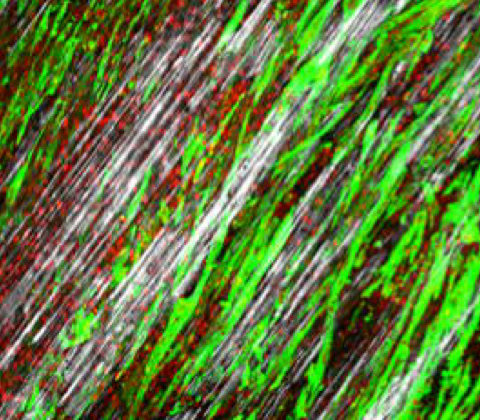
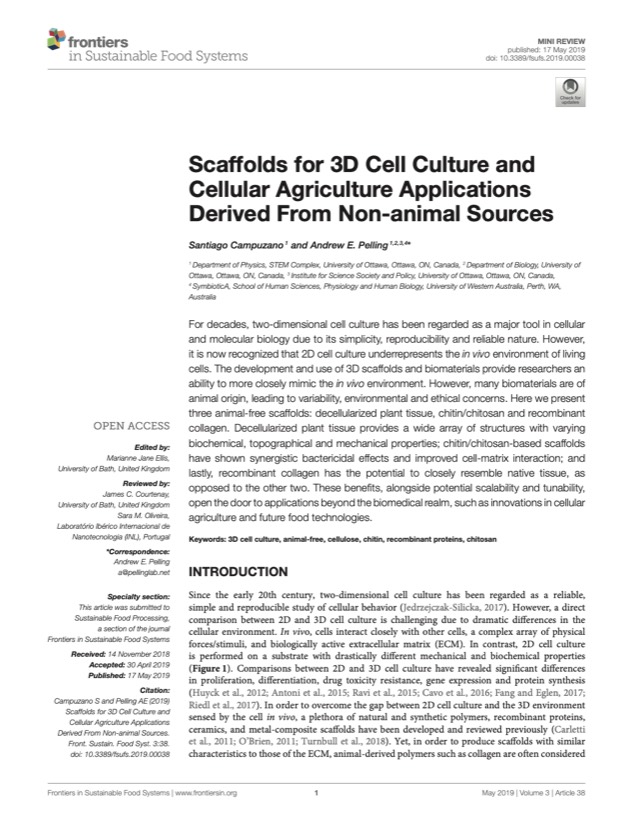
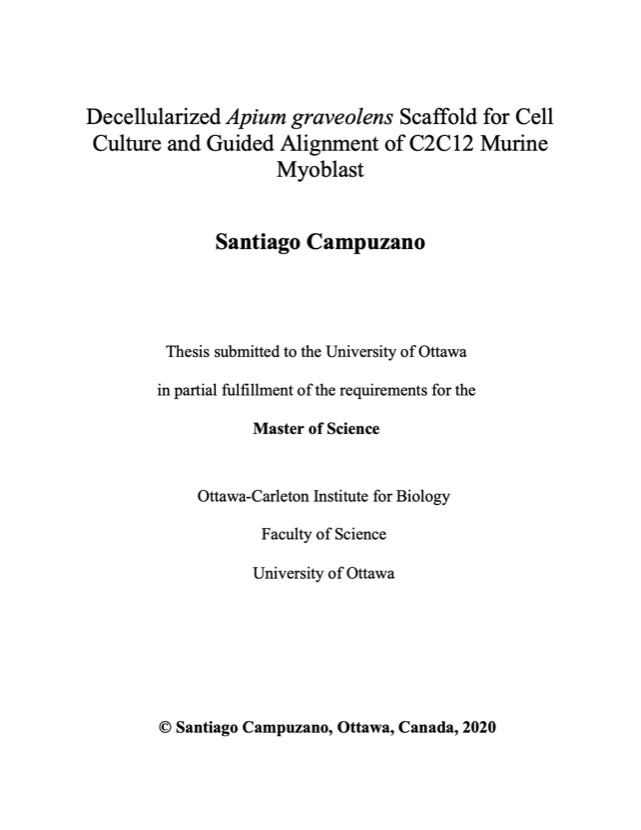
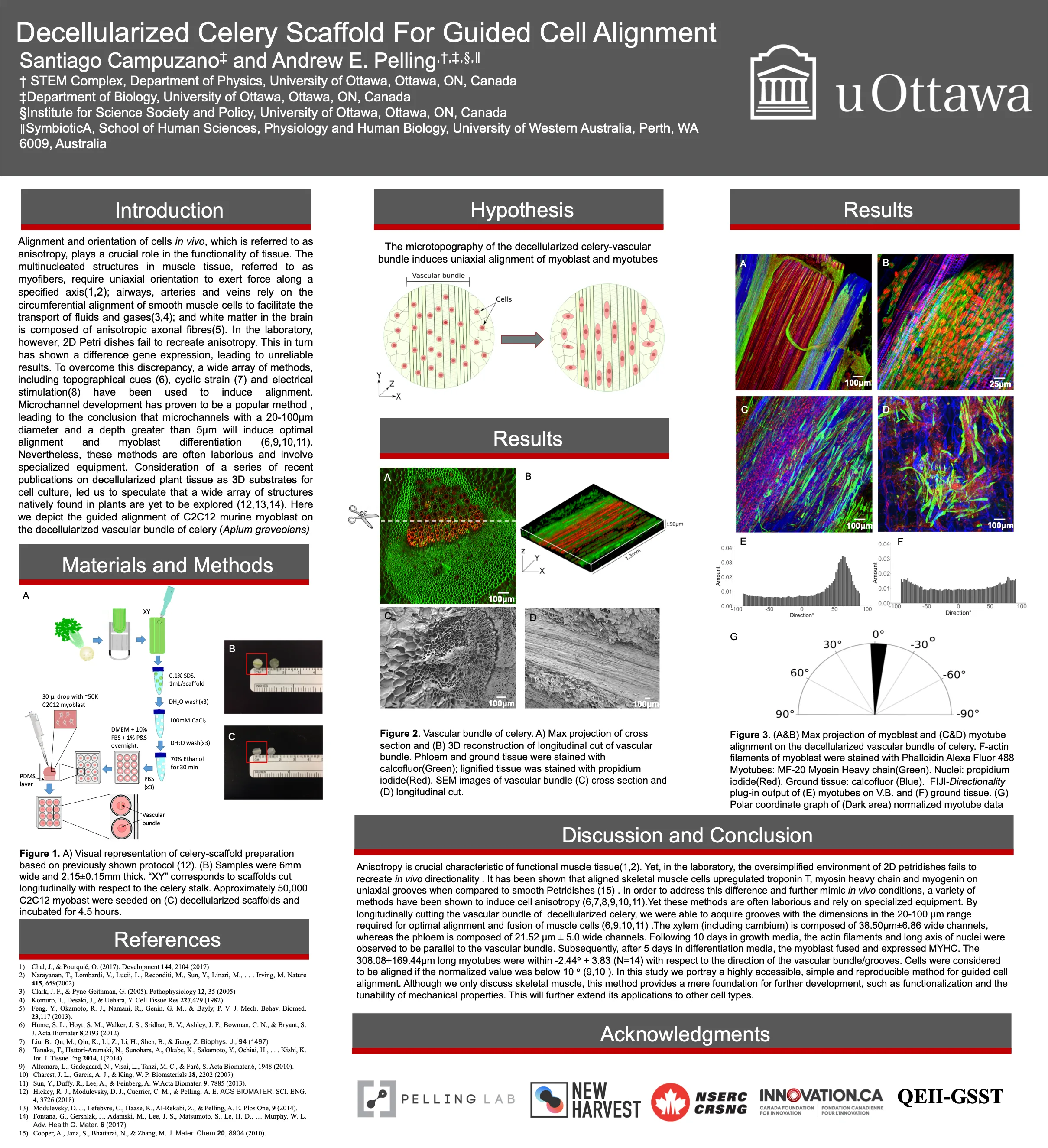
Decellularized celery as a scaffold for muscle. Mouse myoblasts seeded on the vascular bundles lined up along them within ten days and fused into aligned myotubes. Alongside it, a review of animal-free scaffolds for cultured meat: plant tissue, chitin and chitosan, and recombinant collagen. The two papers have been cited more than 100 times. A New Harvest Fellowship and a Queen Elizabeth II Graduate Scholarship funded it.

Confocal image of a celery vascular bundle: magenta plant cell walls around a cluster of yellow vessels Scanning electron micrograph of decellularized celery in cross-section Scanning electron micrograph of long parallel channels in a celery vascular bundle Merged micrograph: green muscle fibres pointing every which way among red nuclei and white plant cell walls Merged micrograph: green muscle fibres lined up along the white vascular bundle, red nuclei between them

A vascular bundle in celery, under the confocal. These bundles run the length of the stalk.

Celery after decellularization, in cross-section. The plant's cells are washed out and the cellulose frame stays.

Along a bundle, long parallel channels: the grooves that line the cells up.

Off the bundle, on the ground tissue, the myotubes point every which way.

On the bundle, the same cells fuse into myotubes lined up along it. Muscle in green, nuclei in red, plant in white.

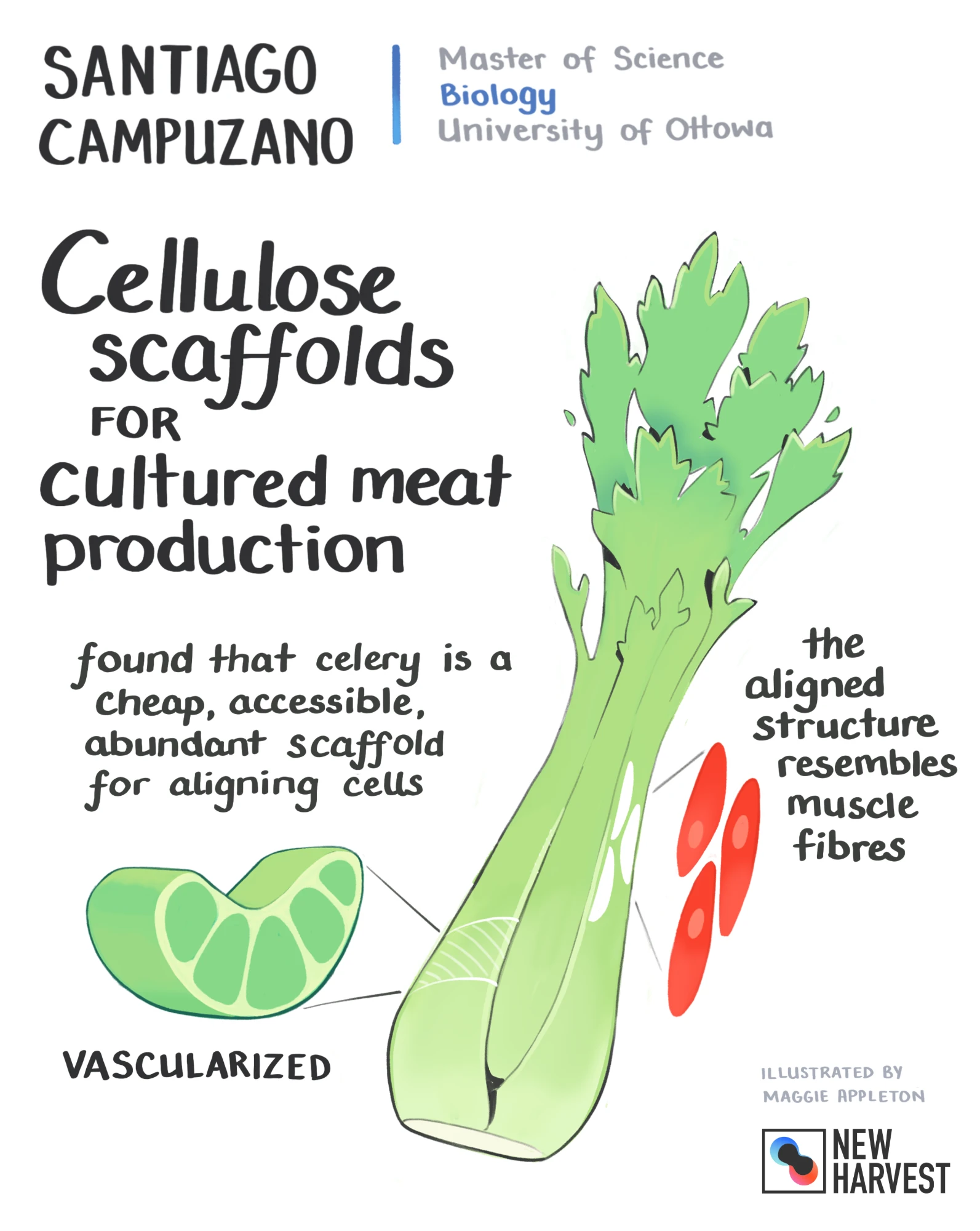
Illustrated summary of my MSc: cellulose scaffolds for cultured meat production. Celery is a cheap, accessible, abundant scaffold for aligning cells; it is vascularized, and its aligned structure resembles muscle fibres.
Conference poster, Decellularized celery scaffold for guided cell alignment, by Santiago Campuzano and Andrew Pelling, University of Ottawa: the hypothesis that celery's vascular bundles align muscle cells, materials and methods, confocal and electron micrographs of the scaffold, aligned myotubes with a polar plot of their direction, and the discussion.

Education

  • MSc in Biology, University of OttawaPelling Lab: decellularized plant scaffolds for muscle2017 to 2020
  • Food science, University of British ColumbiaUndergraduate thesis on cellulose nanofibres and bacterial cellulose2017

Interview

Play the interview, 34 min

Listen on

34 min, 2021

Papers and thesis

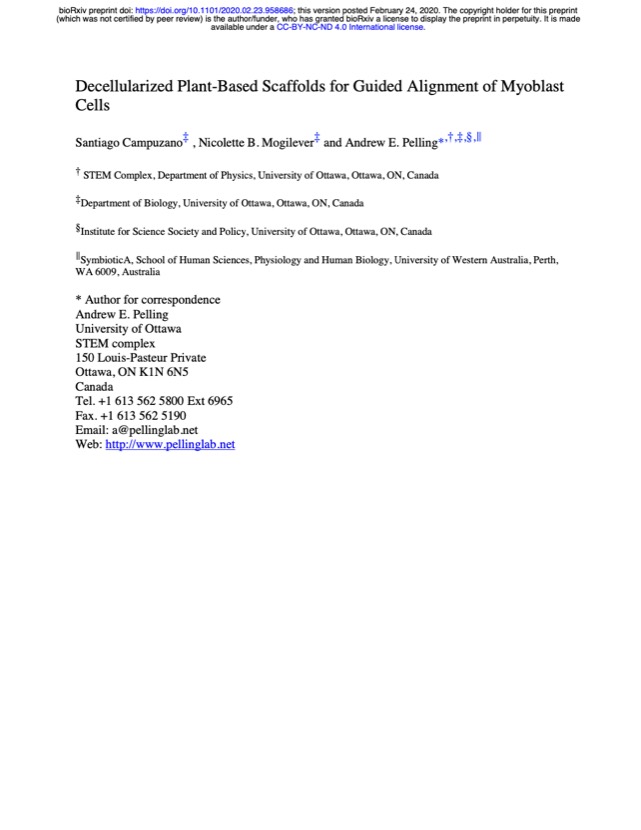
The first page of each. Open one to read it.

Off the clock

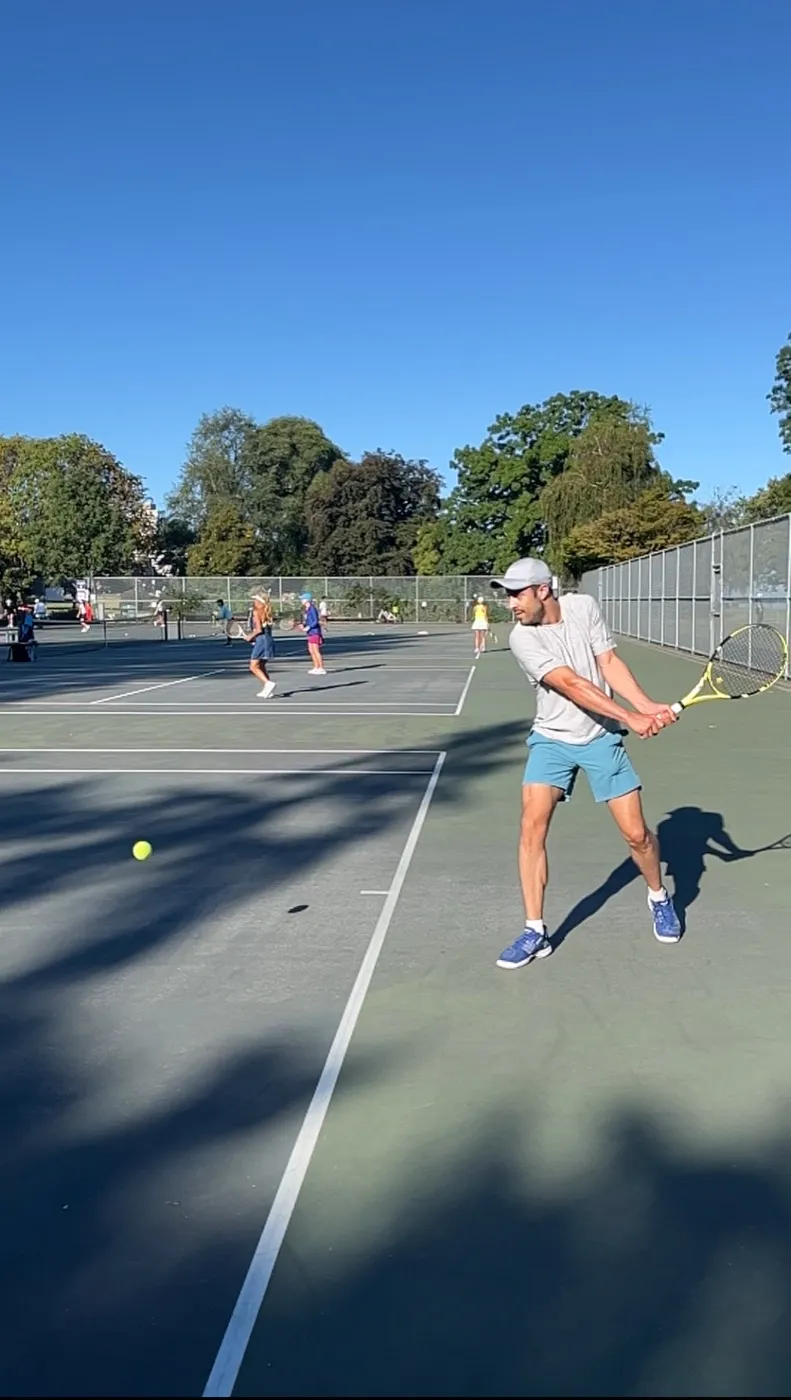
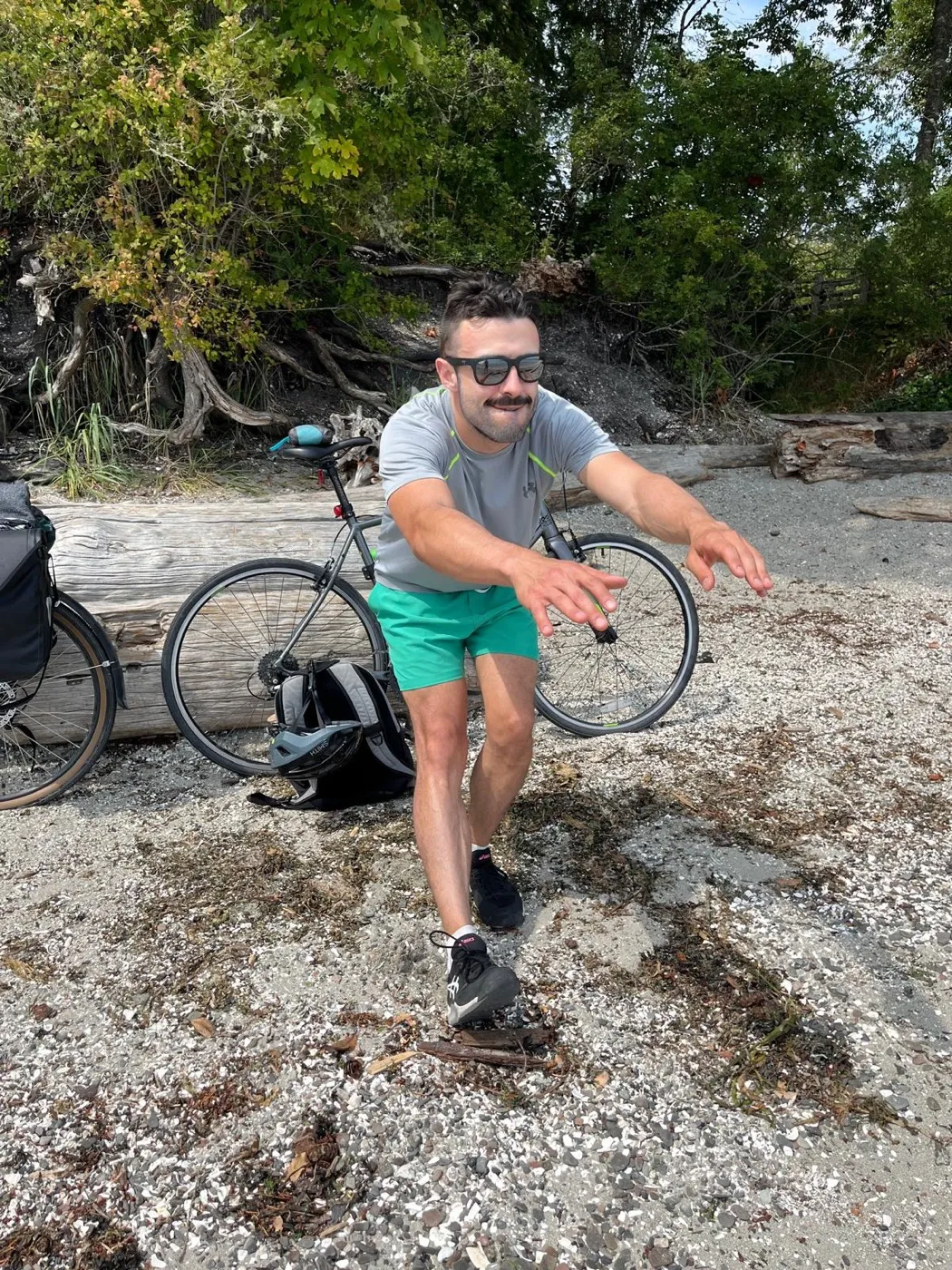
Outside the lab I'm usually on a tennis court or on my bike. Tennis is also why I built SpinMap. Rides take me out past the farms and down to the beach.

Tennis and cycling, around Vancouver

Santiago hitting a two-handed backhand on a sunlit public tennis court
Tennis
Santiago striking a pose on a pebble beach, his bike leaning on a driftwood log behind him
A stop on a ride
Santiago in a cycling helmet and sunglasses, riding past farm fields in evening light
Out past the farms on Vancouver Island

Contact

Write to me about computer vision, lab automation, CAD, or a court SpinMap is missing.

Portrait of Santiago Campuzano

Working on something like this?

Vancouver, British Columbia

Microscopy from Campuzano, Mogilever and Pelling, bioRxiv 2020 (CC BY-NC-ND 4.0). Celery illustration by Maggie Appleton for New Harvest. Talk stills from New Harvest and the Cultured Meat and Future Food Show on YouTube. Product images and marks from STEMCELL Technologies, stemcell.com.